







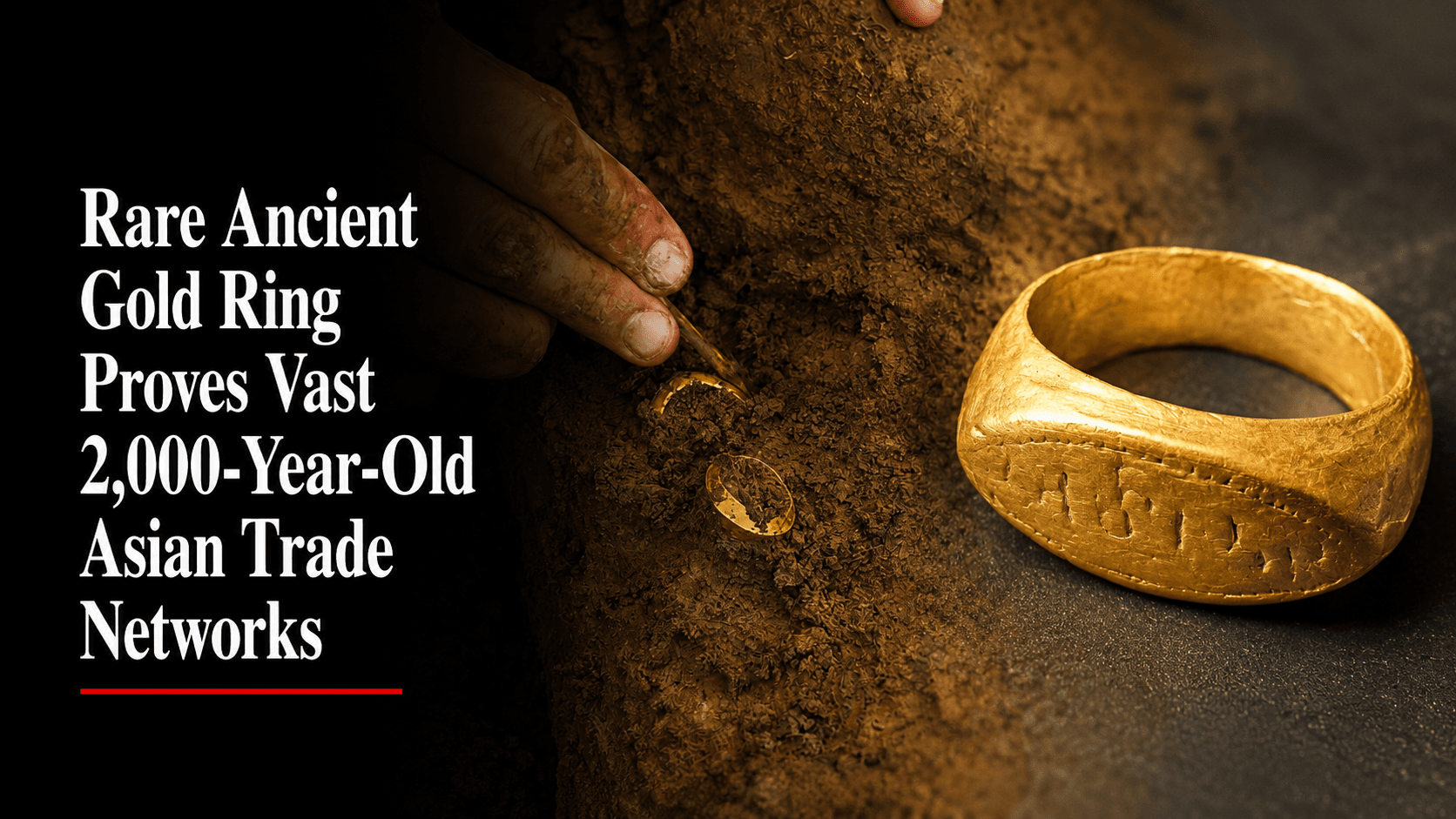
BANGKOK, July 17 – A fascinating archaeological discovery in western Thailand has revealed deep civilizational connections across the ancient Indian Ocean network. Excavators exploring an Iron Age burial site have recovered a pair of highly valuable 2,000-year-old ornaments. Surprisingly, one highly detailed ancient gold ring features a secret protective message written in an ancient Indian script.
The Rare Inscription
The discovery occurred at the Don Yai Thong archaeological site in Phetchaburi province, located about 80 miles southwest of Bangkok. Workers initially stumbled upon the area after finding historical bronze drum pieces in a local rice field earlier this year. Consequently, professional researchers launched a deep dig that eventually exposed nine ancient human skeletons.
The primary ancient gold ring features a distinct, well-preserved engraving in Brahmi script. This writing system serves as the foundational root for many modern languages spoken across South and Southeast Asia. Experts read the custom text as “pusarakhitasa,” a phrase translating directly to “the one protected by Pushya”.
Astrological Meanings
Furthermore, cultural historians link this protective blessing directly to ancient cosmic beliefs. Pushya represents a highly auspicious lunar constellation within traditional Vedic astrology. The language used indicates that the object functioned as a personal amulet to ward off evil and guarantee a safe passage into the afterlife.
“This small artifact acts as a clear record left behind by early travelers,” a research coordinator explained during a weekend briefing. “It shows how easily religious ideas crossed massive geographical distances.”
Tracking Ancient Merchants
The second ancient gold ring recovered from the burial context contains no markings or patterns. Meanwhile, the unique combination of expensive items and specific positioning suggests the owners held a higher social status. Skeletons were ritually placed facing toward the northeast with protective bronze covers resting over their heads.
Therefore, state specialists believe the artifacts belonged to elite traders from the Vaishya social class of ancient India. These maritime merchants frequently crossed dangerous open waters to establish regular business outposts in Southeast Asia. The Fine Arts Department plans to process the remaining skeletons through 3D scanning technology and carbon dating systems before setting up a permanent museum exhibition for the public.