






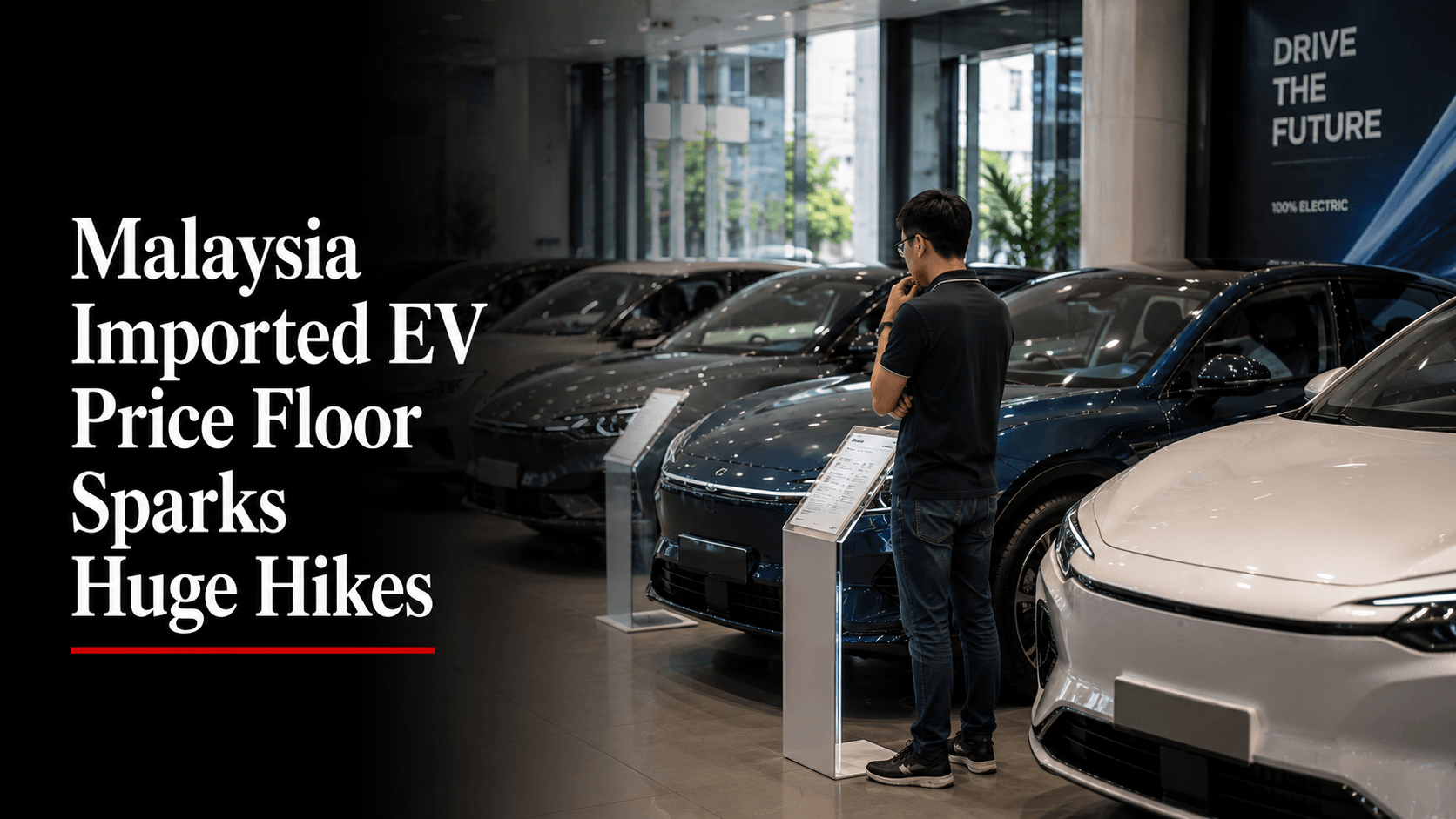
KUALA LUMPUR – The Ministry of Investment, Trade and Industry (MITI) will implement strict new regulatory rules for fully imported electric vehicles starting July 1. Specifically, the newly enforced Malaysia imported EV price floor mandates that all completely built-up (CBU) electric cars must have a minimum Cost, Insurance, and Freight (CIF) value of RM200,000. Once local taxes, duties, and dealer margins are factored in, showroom prices for imported models will drastically spike to at least RM300,000.
Stricter Rules Eliminate Affordable Entry-Level CBU Imports
The policy shift effectively signals an abrupt end to the era of affordable, mass-market imported electric cars in the country. For instance, popular entry-level CBU models from global brands like BYD, GWM, and MG will no longer qualify for cheap local distribution. To obtain import approval, foreign vehicles must also produce a minimum power output of 180 kW. Therefore, this dual-requirement framework pushes the Malaysia imported EV price floor into premium luxury territory.
Furthermore, automotive analysts note that the sudden rule adjustments are designed to alter long-term manufacturing behaviors. The state wants global automakers to stop treating the local market as a dumping ground for low-cost, fully assembled foreign stock. By locking in a steep Malaysia imported EV price floor, the government is aggressively forcing global brands to build local, completely knocked-down (CKD) assembly lines. Consequently, carmakers without near-term local assembly blueprints must completely re-evaluate their regional business strategies.
Stock Exemptions Offer a Brief Reprieve for Early Buyers
Despite the intense showroom price shocks, a temporary logistical exemption will soften the initial transition phase for dealerships. For example, any physical vehicle stock already sitting in local showrooms or currently in ocean transit will remain exempt from the new rules. Buyers can still purchase these existing entry-level imports at their original lower prices until inventories are fully exhausted.
Protecting Domestic Auto Investments via the Price Floor
Meanwhile, institutional researchers expect the regulatory changes to provide a massive competitive buffer for domestic assembly operations. Local automotive giants like Proton—with its new e.MAS 7 line—and Perodua stand to capture the mainstream EV market entirely free from cheap Chinese import rivals. This protective environment ensures that the Malaysia imported EV price floor successfully safeguards multi-million ringgit localized industrial investments. Ultimately, while this policy transition heavily penalizes budget-conscious consumers, it secures Malaysia’s long-term transformation into a regional EV manufacturing hub.