







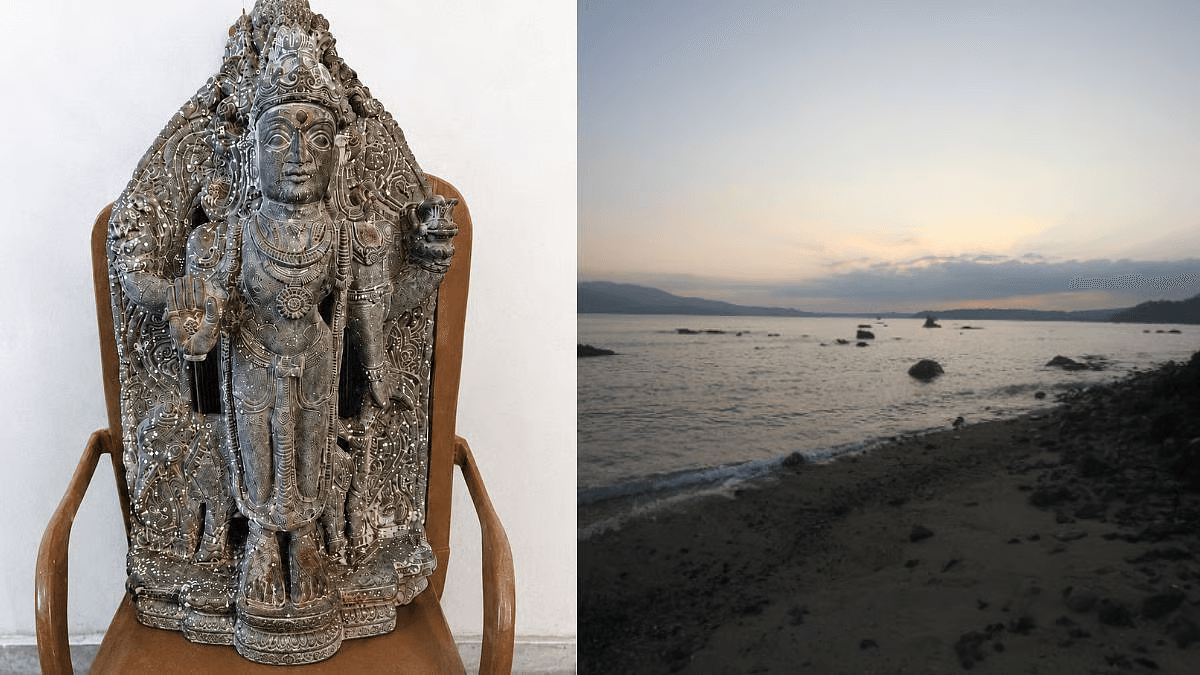
KARAIKAL — A 500-year-old stone idol recovered from the Bay of Bengal by local fishermen off the Mahabalipuram coast has sparked a major heritage smuggling investigation, with authorities suspecting the artifact was dumped overboard during an illegal transit to Sri Lanka, officials confirmed.
The artifact, displaying distinct architectural and stylistic markers of the Vijayanagara Empire, is currently undergoing detailed material and origin testing while under tight government custody.
The Discovery at Sea
The recovery was made on July 10, 2026, by a 16-member crew operating a mechanised fishing vessel out of Karaikal, Puducherry. The crew had originally set sail from the Karaikal Fishing Harbour on July 2 for a multi-day deep-sea expedition.
According to administrative logs, the fishermen noticed their nets becoming unusually heavy around midnight while trawling off the Mahabalipuram coast of Tamil Nadu. Upon hauling the nets aboard, they discovered a large stone deity heavily encrusted with marine deposits, shells, and thick sediment, indicating prolonged submersion on the seabed.
Upon returning to port, the crew immediately alerted local administrators and surrendered the artifact. Karaikal Deputy Collector Pooja formally took possession of the idol to ensure its safe custody and preservation.
Dual Investigation: Smuggling vs. Shipwreck
While initial theories pointed to a historical maritime shipwreck along the active mercantile trade routes of the Coromandel Coast, law enforcement agencies have significantly intensified their focus on active antiquity smuggling networks.
- The Sri Lanka Route – Investigators suspect that the heavy stone deity may have been illegally sourced from a temple in Tamil Nadu and was being smuggled via sea routes to Sri Lanka.
- Tactical Disposal – Police are investigating whether the smugglers deliberately threw the heavy relic overboard to destroy evidence and evade detection during a high-seas chase or patrol interception by maritime authorities.
The Tamil Nadu Idol Wing CID has officially joined the probe. Officers are currently cross-referencing active databases of missing and stolen temple artifacts across southern India to determine if the recovered deity matches any documented temple thefts.
Next Steps in Scientific Verification
- Stylistic Analysis – Specialist teams are studying the iconographic details of the sculpture to trace its precise school of art, currently believed to belong to the late medieval Vijayanagara era.
- Petrographic Testing – Experts from the Archaeological Survey of India (ASI) are scheduled to run material and petrographic assessments. This chemical analysis of the stone will help pinpoint the exact quarry from which the material was harvested, potentially identifying the specific district or temple workshop where the idol was carved.
The artifact will remain in secure administrative custody in Karaikal pending the final origin report from the ASI.