




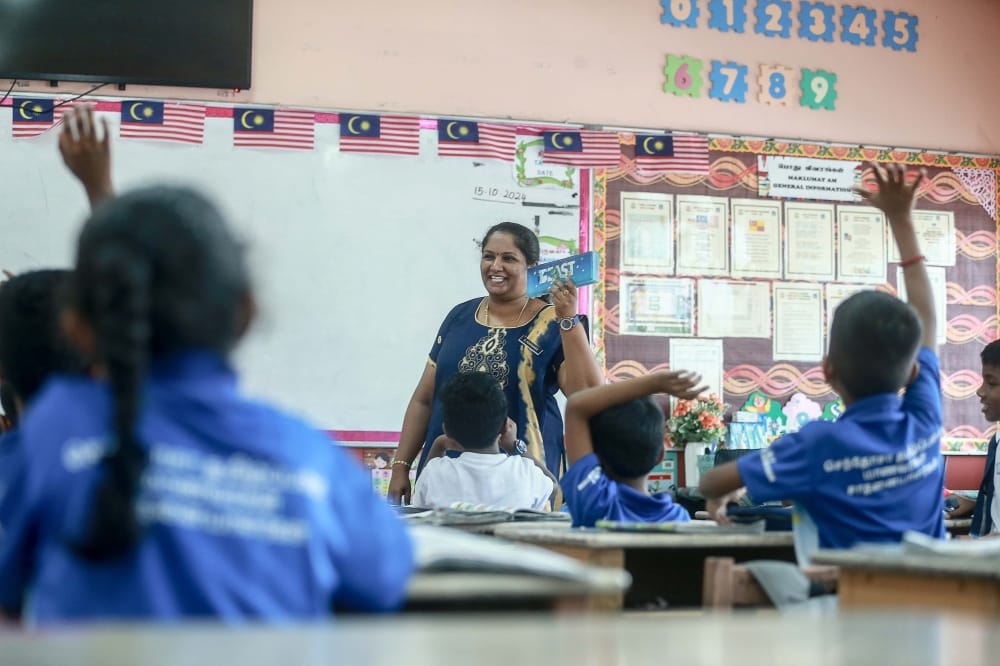
KUALA LUMPUR — The Ministry of Education (MOE) has confirmed that there are currently 528 Tamil national-type schools (SJKT) operating nationwide, accommodating a total enrolment of 78,501 pupils as of May 31, 2026. The data underscores an evolving structural landscape for vernacular education, marked by highly concentrated urban hubs alongside a growing number of low-enrolment rural institutions.
Speaking during a Special Chamber session in the Dewan Rakyat, Deputy Education Minister Wong Kah Woh detailed the ministry’s multi-pronged approach to maintaining infrastructure quality, stabilizing teacher supply, and safeguarding the academic integrity of the Tamil language curriculum.
Tacking the Micro-School Phenomenon
The data reveals a stark divide in school sizes, particularly within Johor. The state hosts 71 SJKTs with 12,906 pupils, but the distribution is heavily skewed. The Johor Bahru district alone holds 15 SJKTs serving 7,840 pupils, driven by highly populated institutions like SJKT Taman Tun Aminah (1,529 pupils) and SJKT Ladang Rini (1,055 pupils). Concurrently, the district houses micro-schools with fewer than 30 pupils, including SJKT Ladang Sungai Plentong and SJKT Ladang Mados.
To systematically manage these under-enrolled institutions, Wong stated that the MOE has deployed a dedicated roadmap:
- Multi-Grade Classes: Implemented across 135 under-enrolled SJKTs nationwide to optimize teaching resources.
- Strategic Relocations: 36 SJKTs have been officially approved for physical relocation to high-demand residential corridors.
- Targeted Capital Injection: The ministry has allocated RM4.3 million each for the construction of new buildings at SJKT Ladang Rini and SJKT Kulai Besar, with each expansion expected to accommodate an additional 200 to 300 students.
Staffing Surpluses and Secondary School Support
Responding to a parliamentary query from V. Ganabatirau (PH-Klang), Wong reassured the House that the supply of specialized Tamil language educators currently exceeds baseline requirements. At the primary school level, the requirement for Tamil option teachers stands at 1,334, while current staffing sits comfortably at 1,733. A similar healthy surplus is mirrored in secondary schools, where 648 teachers are currently active against a baseline requirement of 584.
Crucially, the MOE emphasized that the Tamil language subject remains a permanent fixture within the Examinations Syndicate’s portfolio. Even if a student’s secondary school does not formally offer Tamil classes, they remain fully eligible to register and sit for the subject in the Sijil Pelajaran Malaysia (SPM) examination, provided they meet standard registration criteria. This comes amid a gradual downward trend in overall SPM Tamil candidate registrations, moving from 8,023 in 2023 to 7,494 candidates registered for the current cycle.
Debunking Public Exam Quotas
Addressing persistent public speculation regarding the grading mechanics of public vernacular language papers, the Deputy Minister strongly dismissed the existence of artificial grade quotas.
“Examination results are not determined based on quotas or target percentages of candidates required to obtain a particular grade,” Wong clarified. Instead, the grading thresholds are set using standard international metrics where a panel of subject matter experts, curriculum professionals, and measurement analysts benchmark actual student performance against curriculum competencies. Grade boundaries vary organically year-on-year based strictly on the performance of that specific cohort and the structural complexity of the examination papers.