







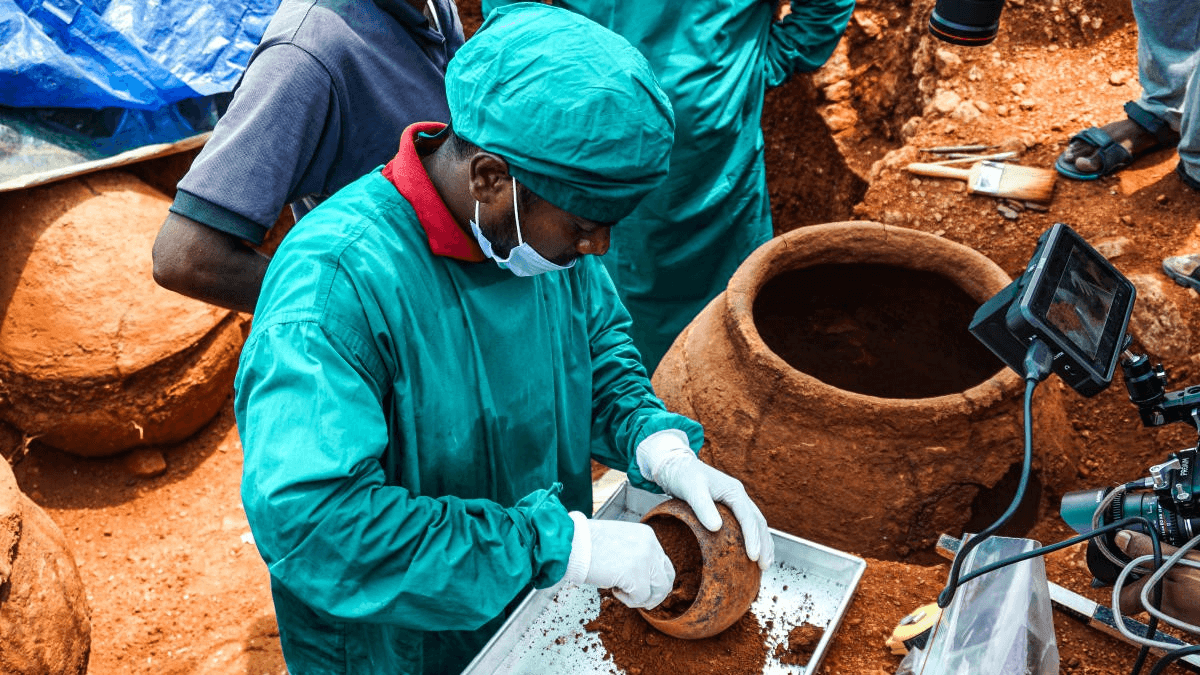
CHENNAI — Excavations at Keeladi have once again demonstrated the ancient origin and cultural heritage of the Tamil people to the world.
Researchers at Madurai Kamaraj University achieved a major scientific breakthrough by extracting and analyzing approximately 75,000 genetic markers from human remains discovered across key Tamil Nadu archaeological sites, including Keeladi, Konthagai, and Adichanallur.
Genetic Continuity and Advanced Sequencing
Using state-of-the-art DNA sequencing methods employed by Harvard University, researchers successfully extracted genetic material from heavily degraded ancient samples to determine their ancestral connections.
According to initial DNA findings, the ancient population shares a direct and close genetic link with modern South Indians, Sri Lankan Tamils, and other South Asian populations.
2,500-Year-Old Culinary Practices Match Sangam Literature
Beyond DNA analysis, advanced protein and chemical testing on ancient cooking pots revealed details of a rich diet dating back over 2,500 years,
- Culinary Traces: Residues of ghee, milk, spinach, and millets were detected in the excavated pottery.
- Literary Alignment: These physical scientific findings align precisely with descriptions recorded in ancient Sangam literature.
Upcoming Global Publications
A total of nine comprehensive research papers detailing these scientific findings are expected to be published internationally later this year.
Scholars view these scientifically proven facts as firm evidence reinforcing the ancient heritage of the Tamil civilization—solidifying its identity as one of the world’s oldest continuous lineages.