







For years, the global discourse surrounding ultra-processed foods (UPFs) has centered primarily on their poor nutritional profiles. Public health guidelines consistently warn consumers to avoid these products due to elevated levels of refined grains, sodium, and added sugars. However, a groundbreaking observational study from researchers at the Food is Medicine Institute at Tufts University challenges this traditional diagnostic paradigm.
Published in the American Journal of Public Health, the study demonstrates that the industrial processing methods themselves play a dangerous, independent role in driving chronic diseases. Even when UPFs are synthetically formulated to meet seemingly “healthy” nutrient criteria, the mechanical and chemical transformation of the underlying food structure remains inherently hazardous to metabolic health.
The Nutrient Quality Paradox
To isolate the specific impact of industrial production on raw nutritional value, the research team analyzed data spanning nearly two decades (1999–2018) from the National Health and Nutrition Examination Survey (NHANES) linked to the National Death Index. Foods were meticulously categorized using a standard classification system based on their manufacturing process, ranging from minimally processed, whole ingredients to industrially engineered formulations.
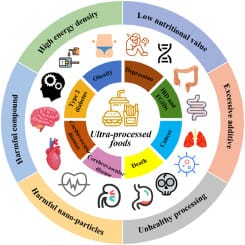
The findings revealed an unyielding correlation, for every 10% increase in calories derived from ultra-processed foods, a patient’s health markers deteriorated systematically. High UPF consumption directly correlated with,
- Elevated body weight and poorer blood sugar control.
- Increased blood pressure and less favorable lipid (cholesterol) profiles.
- A higher prevalence of type-2 diabetes, metabolic syndrome, cancer, and all-cause mortality.
Crucially, these adverse health links remained entirely significant even after researchers statistically adjusted for the actual amounts of saturated fats, added sugars, or sodium present in the food. The systemic damage was not merely a byproduct of the ingredients listed on the label; it was driven by the physical destruction of the food matrix itself.
Altered Biology: What Traditional Metrics Miss
Traditional nutrition metrics score food based on isolated chemical components, but they fail to account for the physical reality of industrial assembly lines.
“The findings suggest ultra-processed-food factors beyond nutrients—such as changes to foods’ cellular structure, loss of beneficial chemical compounds, additives, and chemicals from packaging—may create health risks not addressed by traditional nutrition metrics or policies,” states Dr. Dariush Mozaffarian, senior author of the study and a leading cardiologist.
When natural whole foods are chemically stripped, vital micronutrients and protective natural cellular structures are destroyed. The resulting synthetic matrices interact with the human digestive system in highly irregular ways—altering metabolic pathways, disrupting gut microbiomes, and accelerating the absorption of harmful chemical additives and packaging contaminants.
A Global Public Health Mandate
While the study highlights that UPFs account for a staggering 50% of adult and roughly 60% of childhood caloric intake in Western diets, the structural lessons carry profound global implications for rapidly urbanizing nations. Emerging economies are currently witnessing an aggressive market penetration of packaged, shelf-stable convenience foods replacing traditional, whole-food-based diets.
Relying purely on voluntary corporate reformulations—such as slightly reducing sodium or substituting sugars—is an insufficient defense if the foundational industrial processing techniques remain unaddressed.
To successfully combat the rising global tide of non-communicable diseases, healthcare policies must evolve. This latest evidence underlines an urgent necessity for governments to implement structural, policy-driven reforms. True public health mitigation requires clear regulatory definitions of ultra-processed products, mandatory front-of-pack warning labels, stricter limitations on school meals, and aggressive bans on hazardous industrial additives.