







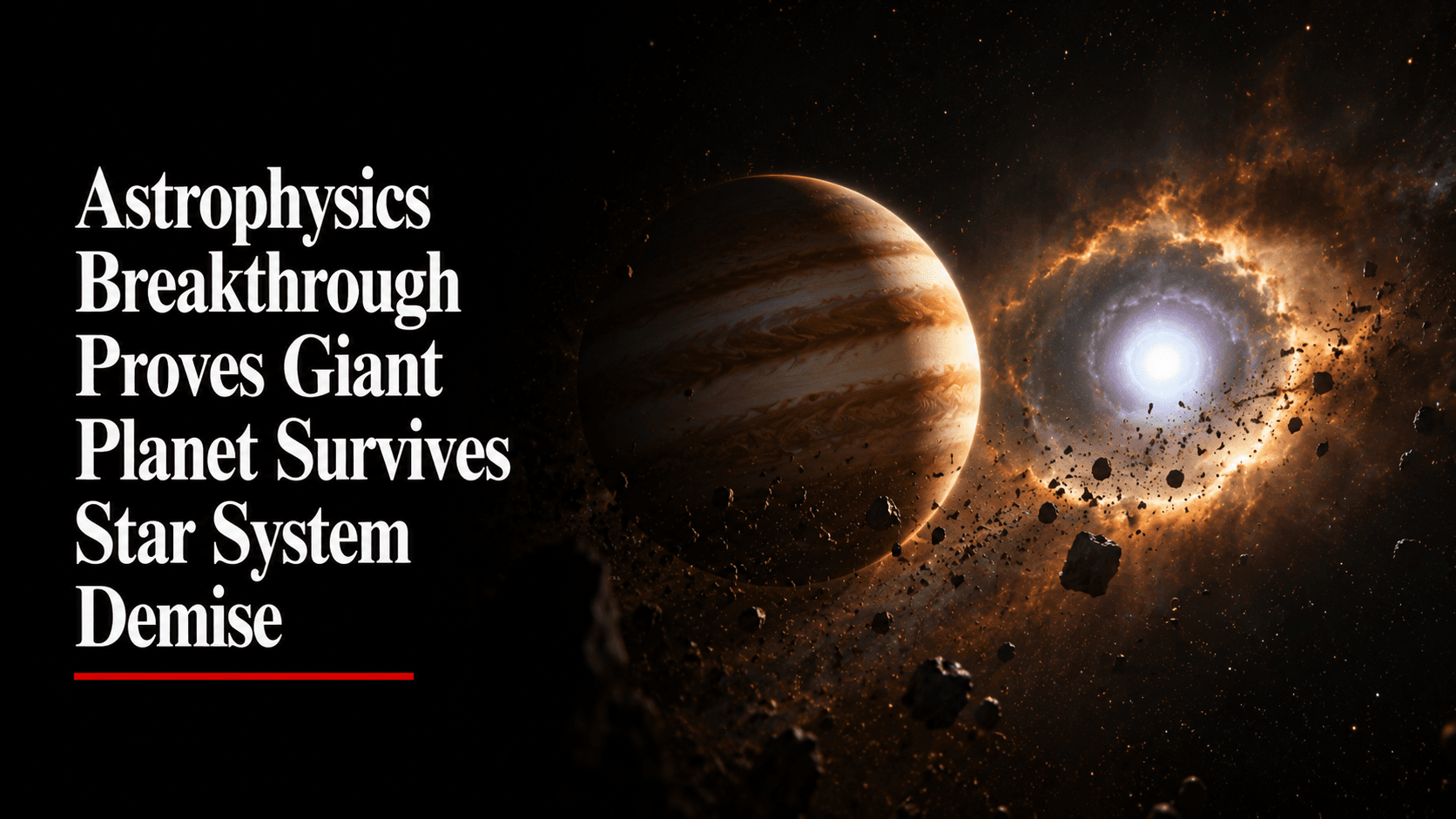
WASHINGTON, July 13 – Groundbreaking new observations from NASA’s James Webb Space Telescope have offered humanity its clearest answer yet regarding the ultimate fate of our Solar System, revealing a bizarre cosmic system where a massive planet survives star death. The peer-reviewed study, analyzing the gas giant WD 1856 b located 81 light-years away, provides structural clues on whether Earth can withstand the violent death throes of our own Sun billions of years from now.
In about 5 billion years, the Sun will completely exhaust its nuclear fuel, swelling drastically into a massive red giant. During this volatile expansion, inner planetary systems—definitively including Mercury and Venus, and quite possibly Earth—will be engulfed and completely vaporized by the blistering stellar plasma. Eventually, the dying star will eject its outer layers, leaving behind a dense, cooling, Earth-sized stellar remnant known as a white dwarf.
The landmark discovery marked the first time astronomers have captured the precise atmospheric signature of a world orbiting a dead star. The target world, a gas giant between 4 and 11 times the mass of Jupiter, is orbiting remarkably close to its white dwarf host, completing a full planetary year in just 34 hours.
“Our results conclusively prove that stellar death is not the absolute end of a solar system. Some worlds experience a vibrant, long-term second act long after their host stars fizzle out,” an international research team member stated during a NASA science briefing.
The spectral readings from the James Webb Space Telescope successfully disproved the theory that the planet had been swallowed up inside the star during the initial explosion. Instead, the data reveals the planet survives star systems by remaining at a structurally safe distance during the high-heat red giant phase, only migrating inward 3 to 5.5 billion years later due to localized gravitational pulls from external celestial bodies.
While this model bodes well for our own gas giants like Jupiter and Saturn, it indicates a far harsher fate for the inner terrestrial zone. Unless the Earth is pushed outward by an unforeseen gravitational anomaly prior to the solar expansion, its physical matter will likely be dissolved before the white dwarf core stabilizes. Space agencies plan to use these baseline findings to target other dead star systems, expanding our map of potentially habitable zones hidden deep within the universe.