







KUALA LUMPUR — Malaysia will permanently phase out its four-decade-old, five-paper written Certificate in Legal Practice (CLP) examination by the 2028/2029 academic year, replacing it with a modernized, computer-based New Bar Course (NBC) focused on practical competencies.
The Legal Profession Qualifying Board (LPQB) confirmed that the transition shifts legal assessments from static written exams to digital evaluations paired with real-world practical performance testing.
Solving the 20% Pass Rate Bottleneck
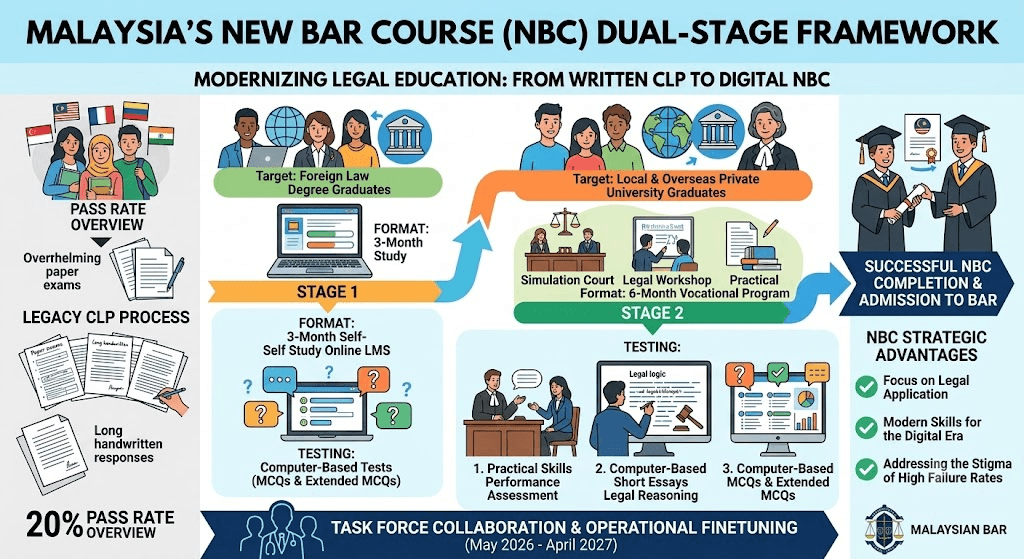
Originally introduced in 1984 as a temporary mechanism for Malaysian law graduates returning from overseas who did not take the English Bar Finals, the CLP grew into a contentious legal gateway. The current five-day handwritten exam structure sees only about 20% of the ~1,000 annual candidates pass, drawing persistent public and industry criticism regarding its reliance on memorization over legal application.
Under the new framework, the Conversion Course (CC) covers core substantive law—including constitutional, criminal, evidence, contract, torts, company, and land law—via LPQB’s upcoming Learning Management System.
The LPPC stage introduces an Objective Structured Performance Assessment to directly evaluate advocacy, client consultation, communication, and professional judgment alongside digital short-essay analysis.
Addressing Mandatory Prep & Local Exemption Realities
Crucially, the LPQB clarified that an active 12-month task force (running May 1, 2026 – April 30, 2027)—comprising public/private university representatives and the Malaysian Bar—is currently finalizing operational rules, including:
- Institutional Accreditation: Setting strict eligibility criteria for higher education institutions to become accredited LPPC course providers.
- Mandatory Participation: Defining whether formal enrollment in accredited preparation modules will be compulsory prior to sitting for computer-based evaluations.
Public university law graduates whose degrees already embed integrated professional modules will remain exempt from the NBC, preserving the traditional pathway while upgrading non-exempt degree tracks to global digital standards.