







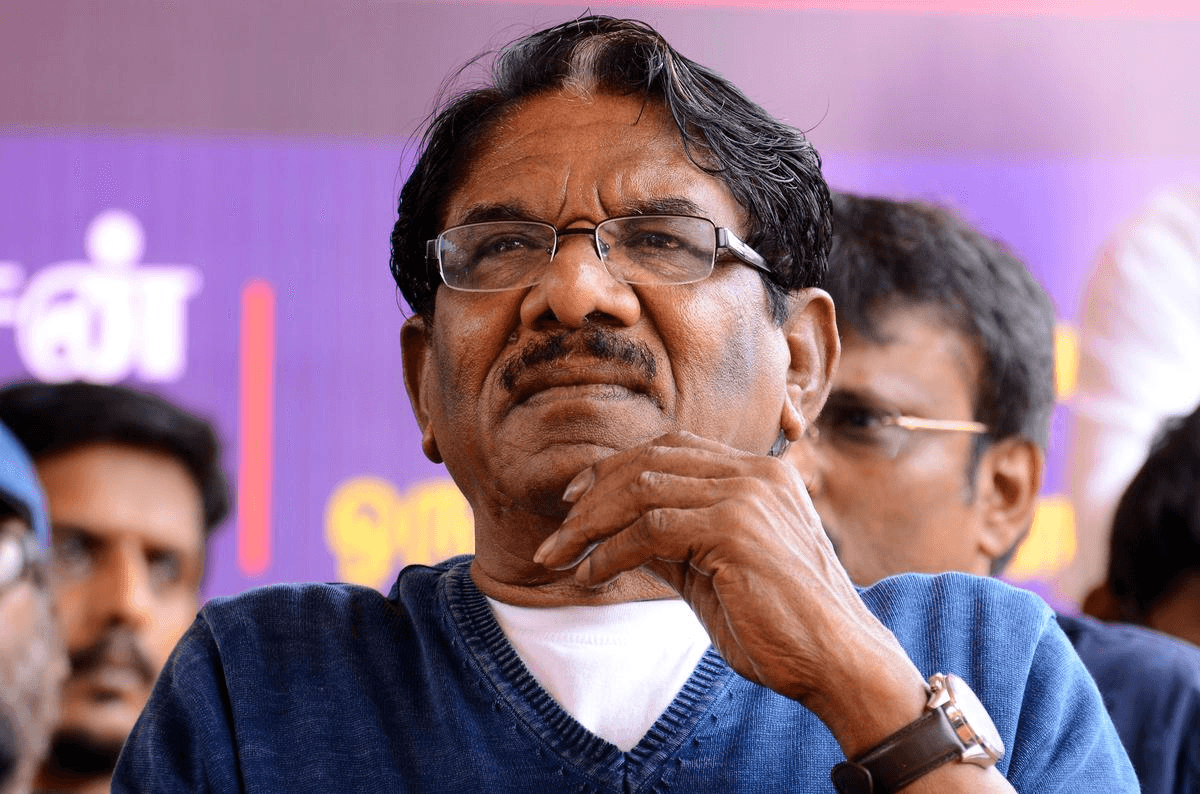
The screen fades to black today, but the echoes of his stories remain in the golden fields of our hearts forever. Bharathiraja, the man who brought the fragrance of the wet earth and the raw truth of village life into the sterile air of cinema halls, has left us. As we mourn the passing of one of the greatest visionaries to ever grace Tamil cinema, we find ourselves looking back at a life that felt like a beautiful and unfolding novel.
To watch a Bharathiraja film was to return home. Before he appeared on the screen, there was that signature moment that every fan remembers. The hands folded in a respectful Namaskaram and the gentle warmth of his voice filling the theater, “En Iniya Tamizh Makkale, unggal paasathukku kuriya Bharathiraja Peasugiren.” Those words were more than a greeting because they were an invitation into a world where emotions were painted in vibrant and honest colors.
He redefined the Tamil film landscape with 16 Vayathinile. It served as a masterclass in versatility, stripping away the artificial gloss of the era to reveal the raw and beating heart of rural India. With Kamal Haasan’s portrayal of Chappani and Rajinikanth’s iconic Parattai, he did not just make a movie. He created a cultural phenomenon that walked away with state awards and changed the trajectory of Indian cinema for everyone who followed.
He possessed a rare gift for navigating delicate subjects without ever sounding like a lecturer. When he directed Karuthamma, the world watched in hushed silence. The review in Ananda Vikatan from December 1994 captured it perfectly when they noted that instead of producing a dry documentary, he narrated a heart-wrenching human experience entirely through visuals. It remains a masterpiece that millions of us, born in the eighties and nineties, still carry in our pockets of memory today.
Bharathiraja did not just make stars. He discovered souls. He possessed an uncanny eye for talent, giving a voice and a platform to legends like Vijayan, Thiagarajan, Nizhalgal Ravi, the brilliant Manivannan, and Thennavan. He was a mentor who pushed boundaries, ensuring that his actors did not just recite lines but lived them completely.
His creative range seemed endless and quite breathtaking. He gave us the psychological intensity of Sigappu Rojakkal, the film that arguably served as the spiritual ancestor to modern classics like Manmadhan. He moved seamlessly from the poignant beauty of Kizhakku Chimaiyile and Pasumpon to the stylish and gripping narratives of Bommalattam. Then there is the hypnotic Kangalal Kaidhu Sei, a personal favorite that showcased his ability to handle urban narratives with the same finesse he applied to rural ones.
He even stepped in front of the camera, proving he was as skilled an actor as he was a director. As the grieving father in Pandianadu, he broke our hearts into pieces. As the cunning politician Selvanayagam in Ayudha Ezhuthu, he made us forget he was an actor at all, and instead, he made us see the political machine in motion.
Music in a Bharathiraja film was never mere background noise. It served as the wind through the paddy fields and the rhythm of the village fountain. From the haunting melody of Kasthuri Mane in Pudhumai Penn to the raw energy of Thirupacchi Aruvale in Taj Mahal, his songs make up the permanent playlist of our lives. He even lent his own voice to Karuthamma, reminding us that he was a man of the people who participated in the very art he helped craft.
We feel an immense sense of privilege to have walked alongside him during his journey. We grew up watching his films, and we learned how to love, how to suffer, and how to forgive through his lens. He showed us that the most powerful stories are not found in distant lands but in the mud, the sweat, and the simple lives of our own people.
He was a storyteller who understood that the human condition remains the same regardless of whether the setting is a quiet village or a bustling city. The camera may stop rolling today, and the director’s chair may sit empty, but the soil he tilled remains fertile. Bharathiraja has returned to the earth he loved so dearly, leaving behind a legacy that will be whispered in the breeze of every village in Tamil Nadu for generations to come. May his soul attains moksha.