





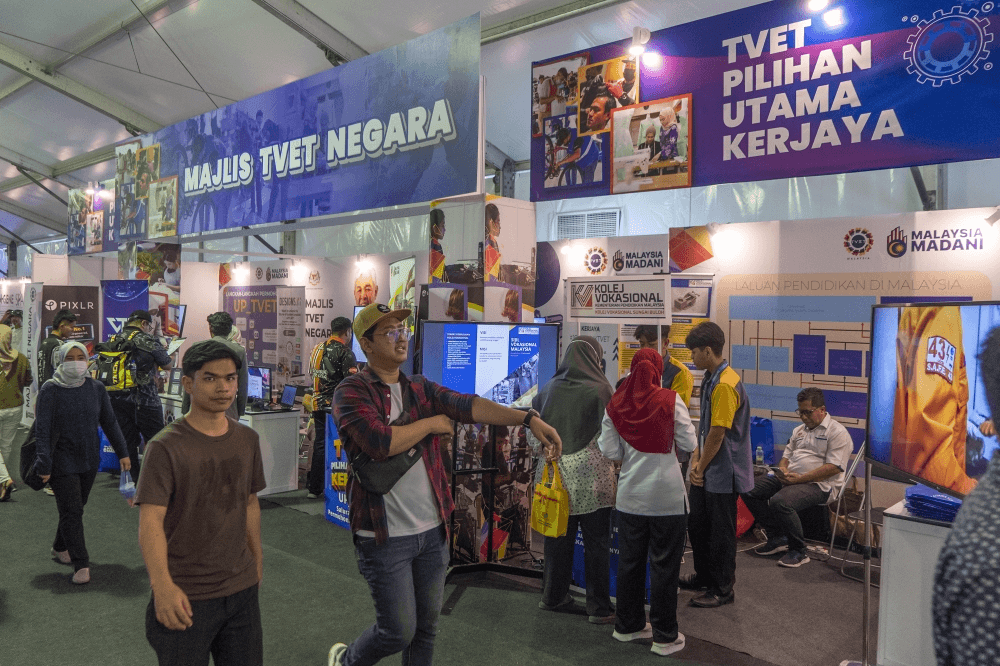
BUKIT MERTAJAM — Technical and Vocational Education and Training (TVET) graduates across Malaysia are being urged to pivot toward tech entrepreneurship to tap into high-value economic sectors and accelerate the nation’s technological growth.
The government is actively driving this shift, backing the vocational ecosystem with a massive RM7.9 billion allocation this year distributed across 12 ministries and agencies. Youth and Sports Ministry (KBS) Secretary-General Datuk Rahimi Ismail explained that the vocational path does not merely train students for traditional employment. Instead, it offers a direct launchpad for young talents to build sustainable, technology-driven businesses of their own.
Data from the ministry reveals the substantial earning potential within this pathway. High-achieving alumni from the National Youth Skills Institute (IKTBN), who successfully scaled their technical ventures into full commercial entities, have hit monthly revenues as high as half a million ringgit.
Speaking at the closing ceremony of the Youth Robot Challenge 2026 (YRoboC ’26) at IKTBN Bukit Mertajam, Rahimi noted that the entrepreneurial potential for local youth remains exceptionally high, with vast market opportunities waiting to be explored.
Powering Green Energy and Automation
The government’s multi-billion ringgit funding is designed to strengthen education and skills training through deep-rooted industry partnerships. By bridging the gap between training institutes and the open market, the state ensures that student skillsets align with modern corporate demands.
While the TVET sector currently boasts an impressive 97 per cent graduate employability rate, the national strategy is shifting focus toward high-growth industries of the future. Key pillars under development include renewable energy, solar infrastructure, automation, robotics, and electric vehicles (EVs). The overarching goal is to transform Malaysia from a simple technology consumer into a primary technology producer and a dominant EV hub within the Southeast Asian region.
Nurturing Global Engineering Talents
This industrial strategy relies on competitive development platforms like YRoboC ’26 to discover and refine young technical minds. Since its introduction in 2018, the competition has brought together 882 teams to showcase innovation and creativity in robotics. The latest three-day edition saw 163 teams face off, drawing international competitors from India.
Teams competed across five intense categories,
- 3KG Autonomous
- 5KG Tower Conquer
- Soccer Robot
- 8KG Rumble
- 16KG Multibot
To expand this culture of innovation, KBS intends to invite teams from Europe and China for the 2027 edition. Plans are also underway to introduce a software robot category to speed up international technology transfer.
Driving the Renewable Energy Shift
Running alongside the robotics tournament, the event marked the launch of the IKTBN Bukit Mertajam Solar Programme. The new facility serves as an accredited training centre for the Grid-Connected Photovoltaic (GCPV) Installer course, granting official competency certifications to its students.
The programme is accredited by the Sustainable Energy Development Authority (SEDA). It successfully welcomed its first student intake for the Solar Installation Electrical Technology Certificate Programme in session 1/2026, with the second intake scheduled to begin classes later this month.