






A sweeping series of federal policies, banking changes, and municipal directives is set to take effect across Malaysia tomorrow, July 1, 2026. The mid-year transitions will introduce immediate structural adjustments to retail banking, public sector administration, local business licensing, and the green automotive market.
For consumers and corporate operators alike, adapting to these synchronized regulatory updates is no longer just a matter of compliance—it is essential for safeguarding immediate cash flow,
The End of the RM1 ATM Fee
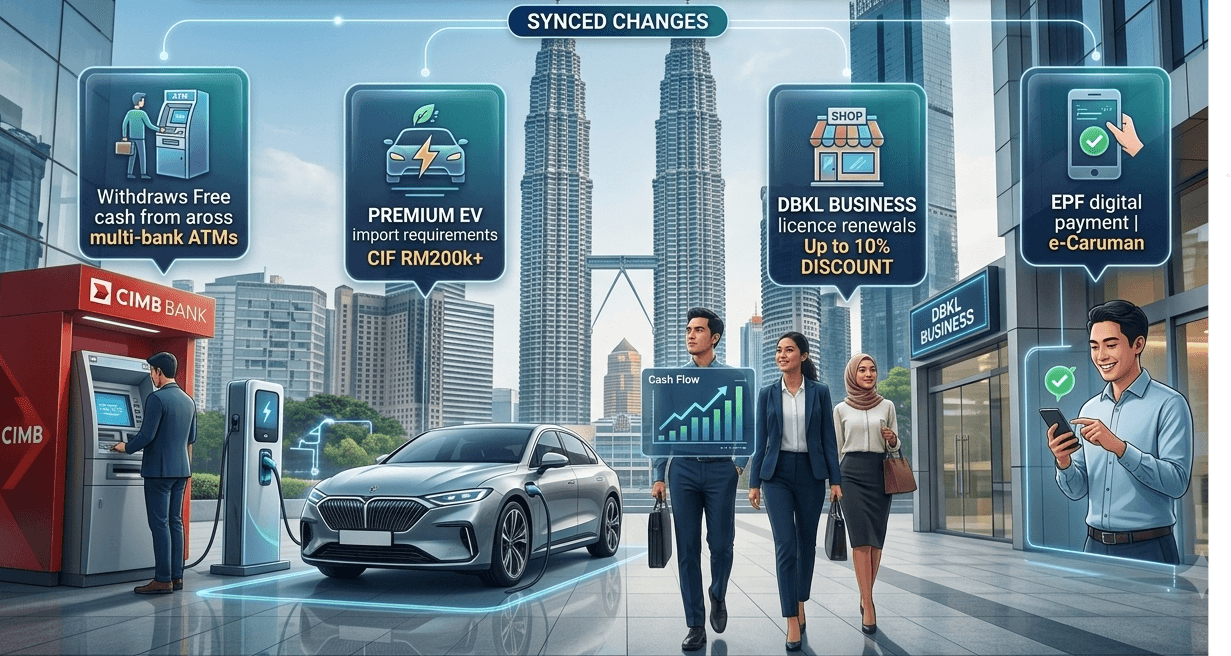
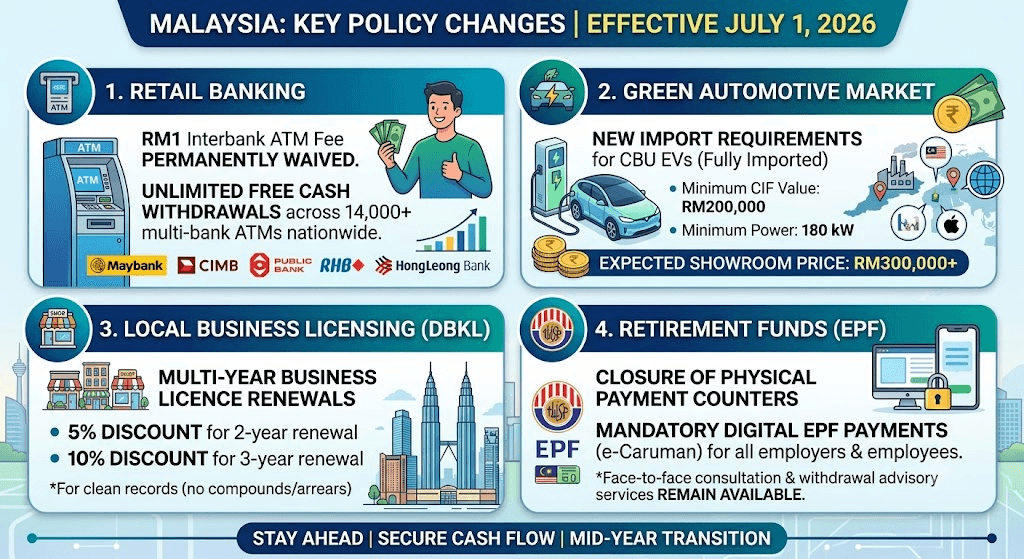
For the general public, the most immediate relief will be felt at retail teller machines. Starting July 1, debit cardholders can perform unlimited cash withdrawals across an expansive network of over 14,000 multi-bank ATMs nationwide without incurring the standard RM1 interbank transaction fee.
By eliminating this micro-transaction barrier, the initiative removes the logistical friction of hunting for a specific banking terminal to access quick liquidity. The policy aims to support lower-income brackets and suburban communities where cash velocity remains high.
Raising the Barrier on Imported EVs
On the premium end of the automotive sector, the Ministry of Investment, Trade and Industry (MITI) is enforcing strict new compliance baselines for completely built-up (CBU) electric vehicles. Under the new rules, imported EVs must meet a minimum Cost, Insurance, and Freight (CIF) floor value of RM200,000 alongside a minimum power threshold of 180 kW.
This pricing floor functions as a protectionist strategy designed to insulate the domestic automotive landscape. By pushing the showroom entry point for imported luxury EVs past the RM300,000 mark, the framework aggressively incentivises global automotive brands to establish local assembly and manufacturing plants within Malaysia.
Streamlining Commerce and Retirement
For enterprises and employers, the remaining directives focus heavily on digital optimization and structural incentives. Within the capital, DBKL is allowing compliant business operators to renew their commercial licences for up to three years at a time. To reward adherence, owners free of active compounds or rental arrears will receive a 5% discount for a two-year renewal and a 10% discount for a three-year renewal.
Concurrently, the Employees Provident Fund (EPF) is permanently shutting down all physical contribution payment counters nationwide. While standard consultation and withdrawal advisory services remain accessible face-to-face, all collection mechanisms and receipting must now occur through online portals. Employers who have delayed migrating to the e-Caruman platform must update their workflows immediately to prevent processing defaults.