






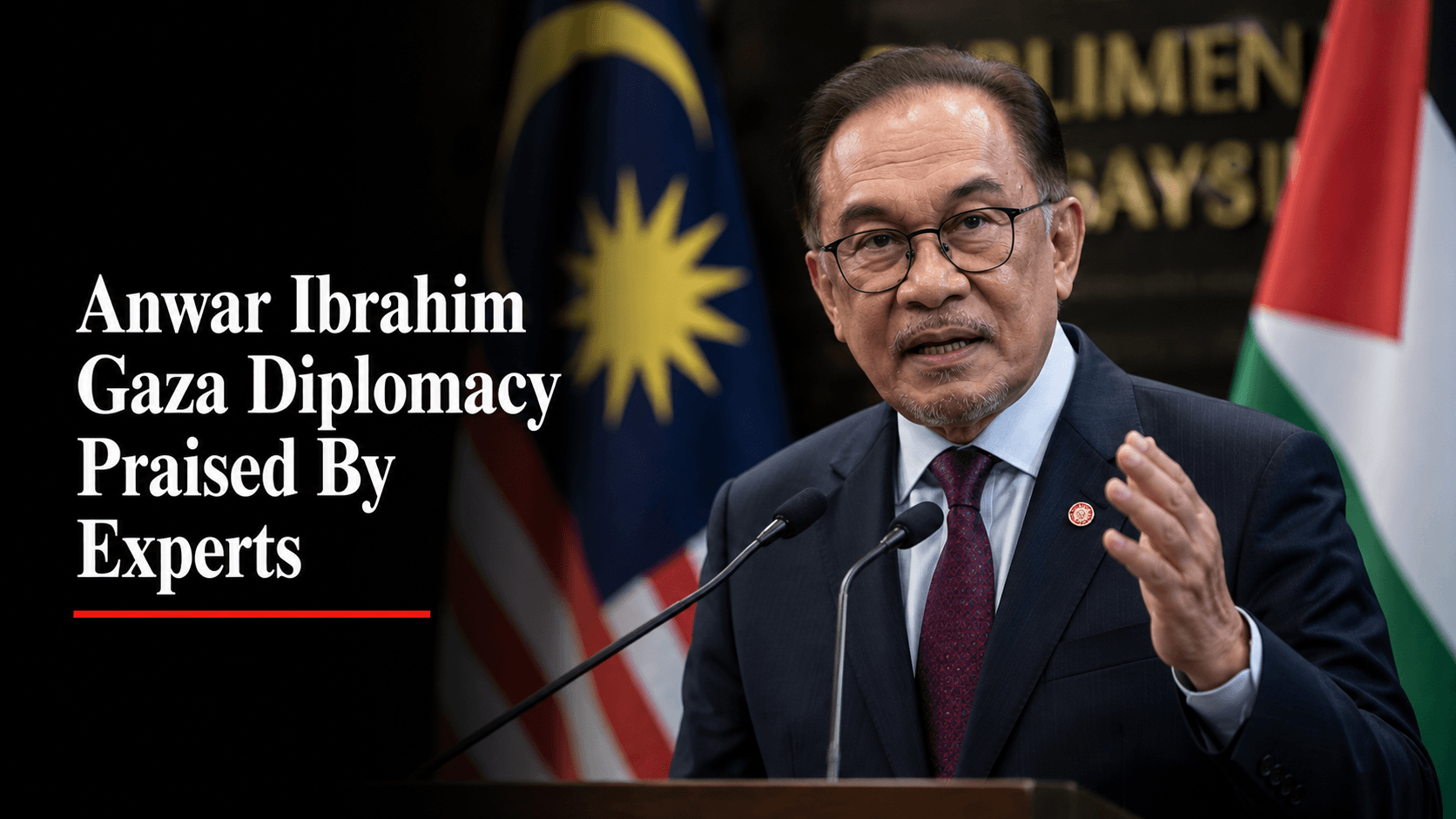
KUALA LUMPUR – Prime Minister Datuk Seri Anwar Ibrahim’s foreign policy regarding the Middle East crisis has received strong praise from regional political analysts. Specifically, experts describe the active Anwar Ibrahim Gaza diplomacy framework as a firm, principled model deeply grounded in international law and humanitarian action. Security observers note that the administration has successfully combined moral messaging with practical international pressure.
Balancing International Law and Global Human Rights
The core strategy behind the state’s foreign policy involves utilizing established international legal channels to address global conflicts. For instance, Malaysia formally backed South Africa’s landmark genocide case against Israel at the International Court of Justice (ICJ). Academic researchers point out that this legal alignment allows a medium-sized nation to expand its diplomatic reach. Therefore, analyzing these legal moves shows that Anwar Ibrahim’s Gaza diplomacy aims to protect long-term human rights rather than satisfy temporary political goals.
Furthermore, regional analysts emphasize that Malaysia’s foreign policy remains highly consistent on the world stage. During recent international summits, the Prime Minister explicitly criticized major global powers for applying international laws selectively during humanitarian crises. He repeatedly warned that ignoring established global rules during times of war risks destroying the baseline credibility of the entire United Nations framework. Consequently, these direct statements help position the nation as a clear, independent voice for developing economies.
Practical Aid Backs the Anwar Ibrahim Gaza Diplomacy
Beyond standard speeches and legal filings, the government has sent significant financial and material support to directly assist displaced civilian populations. For example, the treasury allocated an initial RM100 million humanitarian aid package specifically designated for emergency medical supplies and clean water networks. The state also coordinated closely with regional partners to secure the safe release of locked-down Malaysian volunteers.
Relying on Multilateral Platforms for Global Consensus
Meanwhile, foreign policy experts expect the administration to continue leveraging its ties within the Organisation of Islamic Cooperation (OIC) and ASEAN to build a broad diplomatic consensus. Working through these established regional groups ensures that smaller countries can effectively amplify their security concerns without acting entirely alone. Ultimately, the calculated execution of the Anwar Ibrahim Gaza diplomacy framework proves that a country can maintain clear moral principles while actively engaging in complex global negotiations.