







NEW DELHI – A simple image of a woman delivering groceries on a scooter has ignited a complex national debate in India, led by prominent venture capitalist Anupam Mittal. In a viral LinkedIn post, the founder of Shaadi.com and judge on Shark Tank India questioned the country’s collective obsession with deep-tech, arguing that the focus on AI skilling for all may be a misplaced narrative borrowed from the West.
Mittal’s post, which sarcastically suggested the Blinkit delivery agent should “learn Python” and “fine-tune an LLM,” struck a chord with millions. He contended that while AI and automation are indeed transforming global economies, India’s unique demographic reality—a massive, largely self-employed population—requires a different approach.
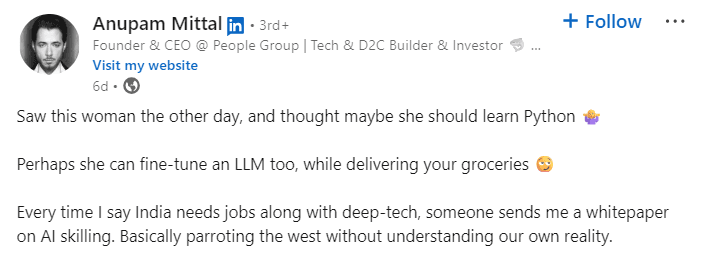

“Every time I say India needs jobs along with deep-tech, someone sends me a whitepaper on AI skilling,” Mittal wrote, warning against “parroting the West without understanding our own reality.”
He drew a stark contrast between Western economies, which have high formal employment rates and established reskilling infrastructure, and India, which is “not there yet.” He shared his experience in the US, where employees were upskilled in real-time as new technology emerged, a system he says is largely absent in India’s informal economy.
According to Mittal, the gig economy, despite its vulnerabilities, has been a “blessing,” enabling employment for millions in a country that is home to nearly 20% of the world’s population. He cautioned that a singular focus on deep-tech as the only solution could “endanger the livelihoods of a billion-plus nation.”
The post resonated with a wide range of professionals, with many comments underscoring the challenges of a purely tech-focused approach. Several users highlighted the digital infrastructure gap, noting that millions in rural areas lack a stable internet connection, let alone access to high-end skilling programs. Others pointed to the practical realities of making a living, where the immediate, tangible income from gig work is more critical than the promise of a future deep-tech job. The sentiment echoed a broader debate about whether to prioritize a two-speed economy—one for the highly-skilled elite and another for the mass population—or to build a truly inclusive ecosystem.
Mittal’s intervention brings a crucial perspective to the table, arguing that India must address the needs of its low-skilled populace simultaneously with its pursuit of technological leadership. The debate is far from over, and its outcome will likely shape the future of India’s workforce and its position on the global economic stage.