





KUALA LUMPUR — Bank Negara Malaysia (BNM) and the Malaysian Investment Development Authority (MIDA) have issued a joint call to overhaul the nation’s wage-setting mechanism, warning that current policy tools raise the income floor while leaving middle-income workers trapped in wage compression.
Speaking at BNM’s Sasana Symposium 2026 (SS2026), BNM Deputy Governor Datuk Marzunisham Omar stressed that adjusting minimum wages without structural career mapping leaves professional starting salaries dangerously close to baseline floor levels.
“When the minimum wage is implemented, it does not cascade into higher income brackets,” Marzunisham said. “Instead, we see wage compression, where starting salaries for qualified professionals remain stagnant near the minimum wage.”
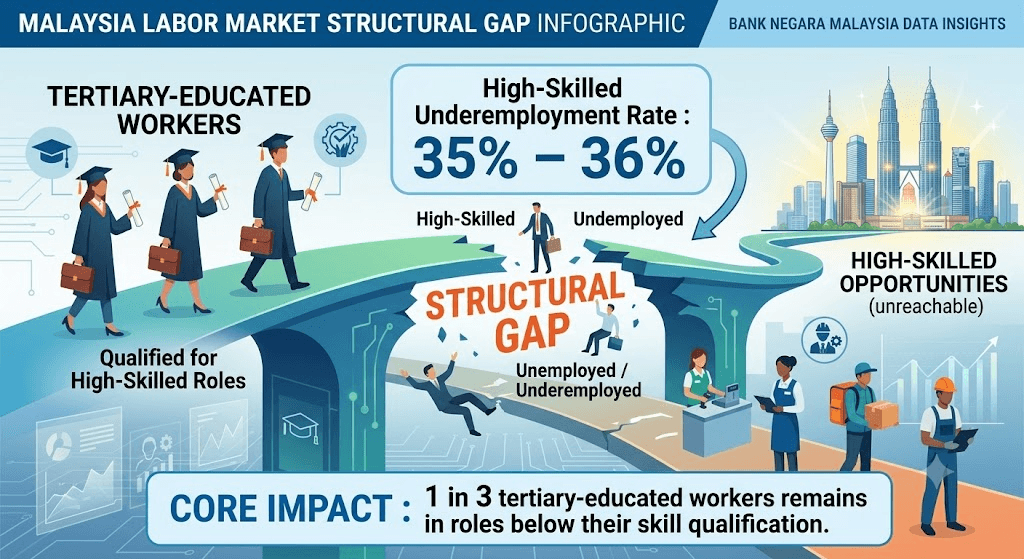
High-Skilled Underemployment Reaches 36%
The central bank highlighted structural labor market imbalances as a prime driver of stagnant earning power, noting that high-skilled underemployment currently stands at 35% to 36%.
To resolve this imbalance, BNM recommended three core pillars,
- Expanding High-Skill Job Creation – Channeling incoming foreign direct investment (FDI) into high-value manufacturing and technology sectors.
- Alternative Pay Structures – Implementing progressive wage policies, living wages, and productivity-linked compensation frameworks.
- Targeted Upskilling – Realigning Technical and Vocational Education and Training (TVET) alongside STEM curricula to directly meet industry demands.
Macroeconomic Growth vs. Household Realities
MIDA Chairman Tengku Datuk Seri Zafrul Abdul Aziz underscored the growing disconnect between headline economic performance and public sentiment. Despite advance estimates showing Malaysia’s economy expanding 5.8% in the second quarter of 2026, household income growth continues to lag inflation and accumulated living costs since the pandemic.
While noting that 90% of approved investments between 2020 and Q1 2026 have successfully transitioned to implementation, Tengku Zafrul stressed that small and medium enterprises (SMEs) require direct productivity support to absorb higher labor costs—such as the RM1,700 minimum wage—without compromising operational viability.